Baltimore Peninsula home to more than half of city’s latest leasing deals
By: Lorraine Mirabella
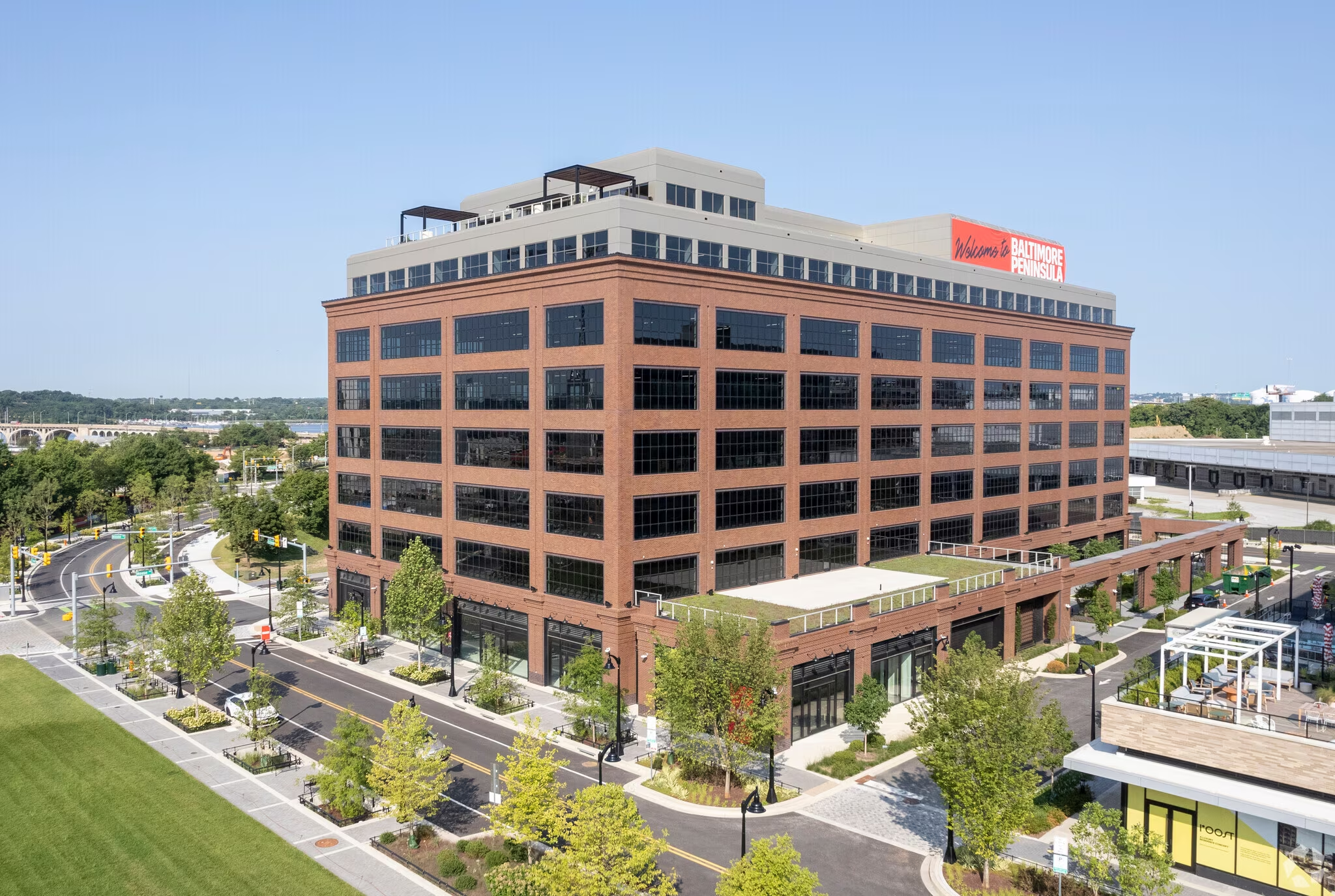
Businesses signed more than half of Baltimore’s commercial leasing deals in the third quarter at Baltimore Peninsula, with a global staffing firm announced Tuesday as the latest tenant in the mixed-use development south of Interstate 95.
Previously known as Port Covington, the waterfront project on a former industrial site leased 53,005 square feet of office space in July, August and September, accounting for 56.6% of the city’s new commercial deals, according to real estate brokerage firm Cushman & Wakefield.
Developers on Tuesday announced a 15,600-square-foot lease with Atlanta-based Insight Global at 2455 House St., bringing the eight-story office building’s occupancy to 75%. The professional services company serves health care, engineering and IT industries at more than 70 locations in the U.S., Europe and Asia.
The company “expands the range of industries represented and furthers our vision of Baltimore Peninsula as a dynamic hub where businesses, talent, and culture gather,” MaryAnne Gilmartin, founder and CEO of MAG Partners, said in a statement.
MAG Partners leads the 235-acre project’s development team, which includes Under Armour founder Kevin Plank, Plank’s Sagamore Ventures investment firm and Goldman Sachs Asset Management Urban Investment Group. The vision for the massive project, touted as one of the largest urban revitalization efforts in the U.S., includes up to 14 million square feet of shops, restaurants, office space and housing, plus 40 acres of parks, across 45 new city blocks.
The House Street building already is home to CFG Bank’s headquarters and several hundred workers, Daily Grind and Molly’s Dog Care. Architecture firm Ayers Saint Gross has signed up for 25,000 square feet and plans to move by spring.
The project, adjacent to Under Armour’s newly relocated headquarters on a separately owed parcel, has leased 90,000 square feet of office space this year to tenants such as the University of Maryland’s Flex MBA program, PwC and Newmark, all at Rye Street Market, a second office building. Developers so far also have built an extended-stay hotel, two apartment buildings and 10 acres of waterfront parks. The office buildings together are 60% leased.
Gilmartin has said the goal is to attract tenants from outside the city and state, rather than merely moving tenants around the city. But critics have raised concerns about additional office space leading to higher vacancies elsewhere in the city, at a time when tenants are fleeing older commercial areas for upgraded, newer space.
Additional shops and eateries are expected to open later this year, adding to tenants such as Ben & Jerry’s, Slutty Vegan, Bar Vegan, Jersey Mike’s and Rye Street Tavern by Clyde’s Restaurant Group.
New York City’s commercial real estate industry has faced wave after wave of challenges in 2025, from the introduction of tariffs and federal funding cutbacks in the spring to the local political uncertainty introduced by November’s looming mayoral election.
The ability to navigate the turbulence is the hallmark of the 27 women who were named Bisnow New York Power Women for 2025, to be honored at a cocktail and awards reception Oct. 8 at 120 Broadway.
The two winners of this year’s Icon and Influencer Award, MAG Partners founder and CEO MaryAnne Gilmartin and MSquared founder Alicia Glen, said sticking to their specialized areas and staying disciplined has been paramount as headlines throw investors into a panic.
Both women have managed to pull together standout moments in NYC’s commercial real estate scene during a moment when other developers have been stuck.
This summer, MAG Partners opened two residential buildings, the 194-unit Anagram Turtle Bay at 300 E. 50th St. and the 188-unit Mabel at 335 8th Ave. MSquared, meanwhile, acquired full ownership of a 1,193-unit property at 3333 Broadway in Manhattanville for $323.5M with a consortium of other investors and recently closed a $140M raise for the firm’s second fund.
But it has been far from easy.
“Never have I seen daily national headlines whipsaw our business the way, or at least for our company, the way that it has since January,” Gilmartin said, adding that ”Liberation Day” — the day that President Donald Trump officially began his tariff campaign — was a “colossal stress inducer.”
The impact of cuts to federal programs has been a particular pain point for affordable and mixed-income housing investors and developers like Glen’s firm. Deals have gotten harder to put together because some resources are no longer available, she said.
“Business is very much focused on the relationship with the public sector and how you leverage government’s policies and capital and money to promote affordable housing,” Glen said.
New York City’s upcoming mayoral election could increase those tensions, Gilmartin said. While she said a potential Zohran Mamdani mayoralty would have minimal impact on the ground-up development business, it could heighten the need for strategic thinking among builders. Trump’s staunch opposition to Mamdani poses a potential complicating factor.
Political uncertainty at home and abroad has led to extra sensitivity and caution in the capital markets.
“Our investors are international, and they tend to be very sensitive to headlines,” Gilmartin said. “War is hard. War is harder when you’re dealing with international investors that are from that region.”
Both have decades of experience helping to shape New York into what it is today — Gilmartin developed the Barclays Center as head of Forest City Ratner, and Glen was the tip of the spear for Mayor Bill de Blasio’s housing policy. While they expressed apprehension about the city’s short-term course, they have long histories of navigating the challenges while being one of few women in the room.
“For women in particular, you do have to be smarter than everybody else in order to get the authority to be in charge, or to raise capital or to run a city,” Glen said. “There are lots of women in the industry, but you have got to really own it, and you had better be the person that is making the decisions.”
NYC Developers Build 99-Unit Buildings to Avoid Wage Requirements
By: Paulina Cachero
A new tax program is leading some developers to change their construction plans.
Iron contractors work on the facade of an apartment building in New York.Photographer: Angus Mordant/Bloomberg
There’s an unmistakable trend across New York City: Real-estate developers are seeking to construct buildings with exactly 99 units. No more, no less.
In the past four quarters, 28 such permits were filed, more than double the total from the previous 16 years combined, according to city data analyzed by the Real Estate Board of New York, a lobbying group.
To those in the industry, there’s no question what’s behind the pileup at that precise number: A new tax program for real estate developments that requires higher worker wages for buildings with 100 or more apartments.
Last year, the New York legislature passed 485-x, which allows developments in New York to receive a tax break if they include a certain number of affordable housing units. It replaces a similar program called 421-a that expired in 2022. However, the new program requires developers of buildings with 100 units or more to pay workers at least $40 an hour — a mandate far more stringent than the prior one.
Developer MaryAnne Gilmartin is a case in point for the results of the program. She once envisioned a pair of 400-unit rental towers on a NYC lot, but she’s now considering as many as six smaller buildings — a patchwork of projects that ultimately would deliver fewer apartments. The revised plan would take longer to execute and cost more per unit, but Gilmartin said this is the more financially viable option for her.
It’s an unintended consequence of an initiative designed to substantially expand the city’s supply of housing, a crucial need at a time when spiraling rents have made life in New York more unaffordable than ever. The Real Estate Board of New York and many developers argue that 485-x hampers their efforts and will lead to fewer units than might have gotten built under the old program it replaced.
The wage requirements “are a huge burden,” said Gilmartin, chief executive officer of MAG Partners. “We’ll build less housing, less quickly, and it’s less financially viable. Frankly, we just have less ability to address this housing crisis.”
Unaffordable Housing
The city’s housing shortage has gotten so dire that every candidate in this year’s mayoral race has a proposal to remedy it. As soaring costs threaten to send New Yorkers fleeing, there’s broad agreement on the idea that the faster more homes can get built, the better. Help has come from state legislators, which passed 485-x last year, while city lawmakers have enacted zoning changes to pave the way for more residential construction — a step toward Mayor Eric Adams’ “moonshot” goal of adding 500,000 units by 2032.
Ahead of the mayoral election, as candidates debate the best ways to alleviate the housing crisis, the new flood of 99-unit buildings is a signal of how changes in policy can have far-reaching and unintended effects.
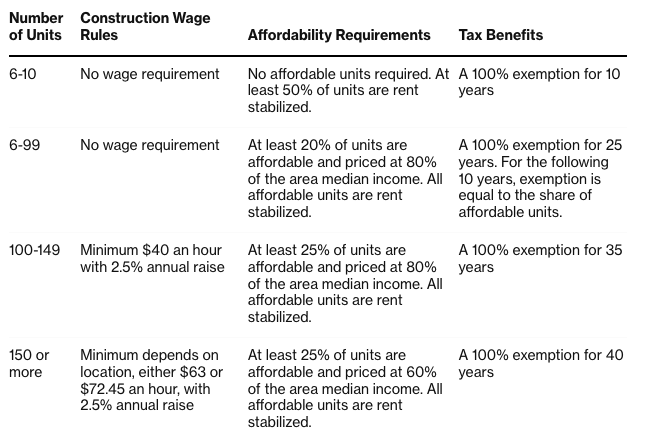
Under 485-x, wage minimums go up with the number of apartments. For example, workers on buildings with 100 to 149 units must be paid at least $40 an hour with 2.5% annual raises. Crews on 150-unit projects would be paid an hourly minimum of $63 or more, depending on the location.
This means affordable housing will be built in “smaller amounts and at a slower pace,” said Daniel Bernstein, an attorney at Rosenberg & Estis who works with developers. “There is going to be more housing produced. But you will not see the amount developed at scale because of the construction-wage requirements.”
485-x Tax Abatement Program
Source: Rosenberg & Estis Note: Outlines policy for rental buildings only
Wage requirements under the previous program, 421-a, kicked in at 300 units and were less stringent, giving developers the ability to pay certain laborers less than others, according to Bernstein. With 485-x, the minimums largely apply across all trades, he said.
On sites with 99 units or less, workers must only be paid the city’s minimum wage of $16.50 an hour. The average hourly wage for an entry-level construction worker is typically $18.30 an hour, while the most experienced workers can get up to $50.38, according to the New York Department of Labor.
In return for the higher wage requirement, 485-x offers more-attractive tax incentives over a longer period of time, Bernstein said.
Higher Costs
But even with those benefits, the 150-unit wage minimum would tack on 20% to a project’s hard expenses, said Gilmartin, who’s considering buildings with 99 or 149 apartments on the site where she would have built two larger towers under the prior program.
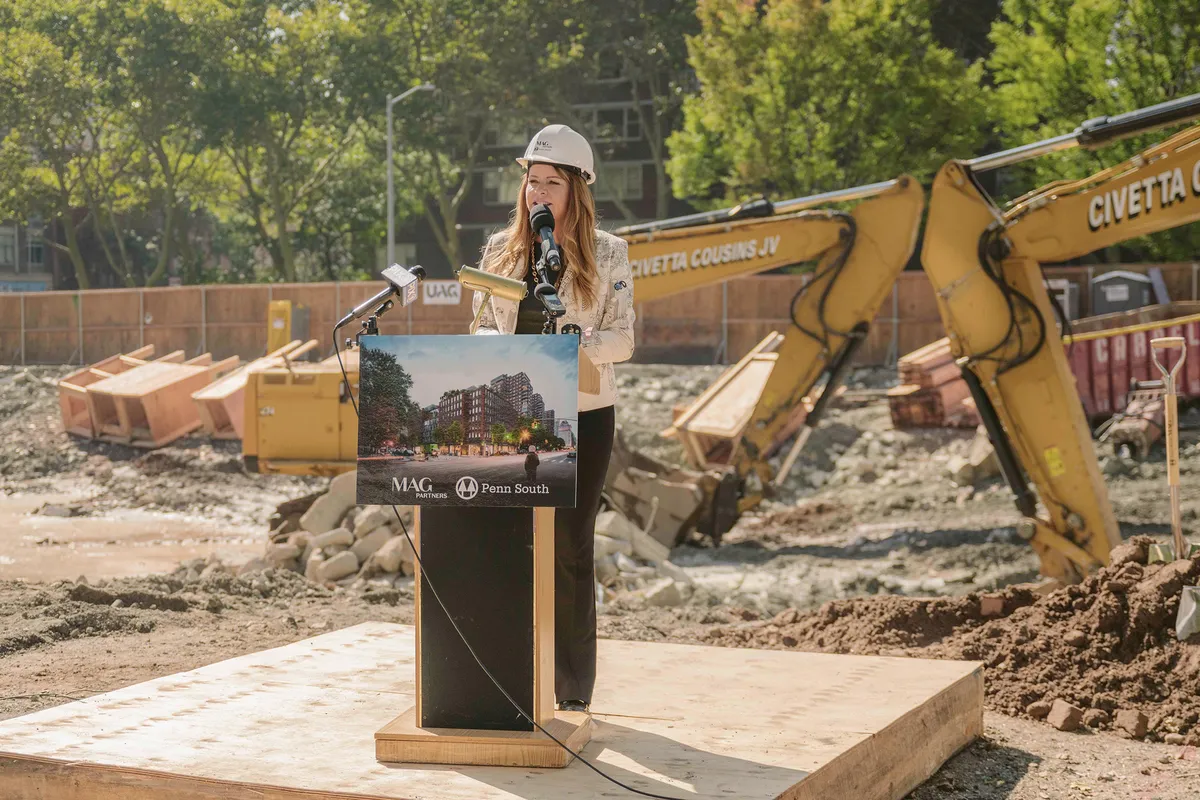
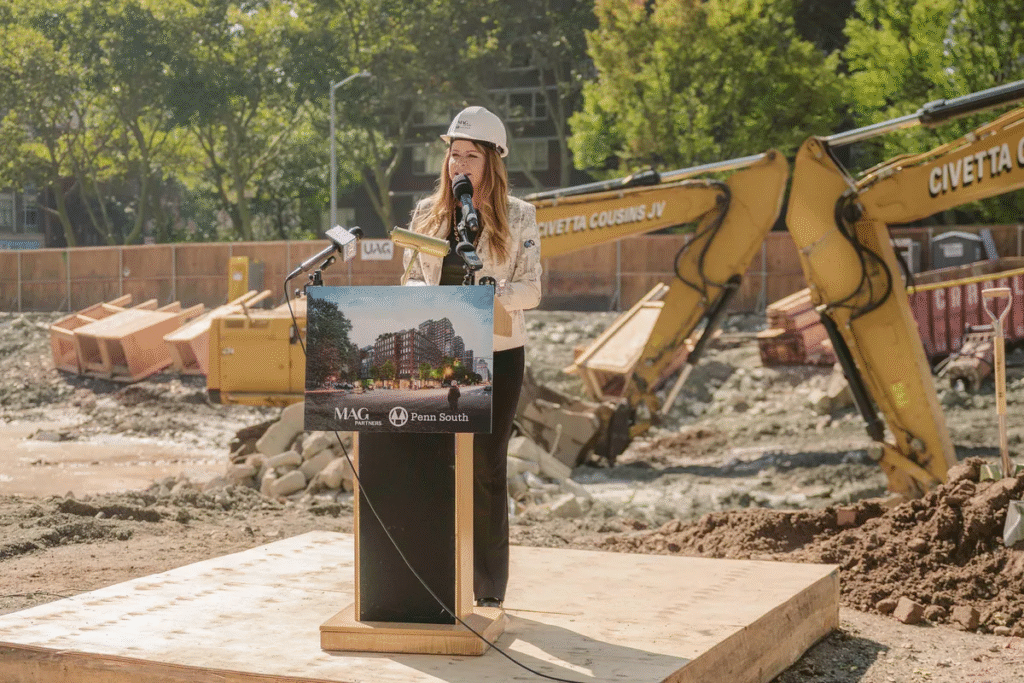
Developer MaryAnne Gilmartin during a groundbreaking ceremony at 335 Eighth Ave. Source: MAG Partners
Add in high interest rates, rising land costs and the looming impact of tariffs, and the math on larger buildings doesn’t make sense, said Rick Gropper, founding principal at Camber Property Group, a New York-based firm that specializes in developing affordable and mixed-income housing.
Other than potentially saving money on wages, a series of smaller buildings enables each to qualify for its own tax break. On the other hand, that means more paperwork and time spent on construction. And whether a property has 99 units or 200, they all have to meet the same standards, making the economics of scaled-down projects complicated as well, according to Gropper.
“You still have to have an elevator and other building requirements, with only 99 units to offset those costs,” he said.
While most of the initial 485-x projects are on the smaller side, the New York City Department of Housing Preservation & Development, which manages the tax incentive program, is talking with some companies that are exploring bigger properties but haven’t yet registered plans, a spokesperson for the agency said.
‘Important’ Buildings
REBNY has warned that the city’s housing needs are massive and that while the group supports any program that encourages construction, the wage mandate means 485-x won’t come close to generating enough units to give New Yorkers meaningful rent relief, said Henry Perez-Tlatenchi, a senior policy researcher at REBNY.
Still, midsize buildings are “important,” especially in neighborhoods outside Manhattan, where towers with hundreds of units may not be a good fit, he said.
To be sure, 485-x has jump-started housing production after the expiration of 421-a brought new projects to a standstill. REBNY’s analysis for the second quarter showed 6,943 proposed dwelling units citywide, nearly double the amount seen for the three months through September 2022, the first period after 421-a lapsed.
Affordable-housing advocates say that while they do expect 485-x to spur development, they haven’t yet seen enough evidence that the program is working as intended.
“It’s important that we are maximizing zoning on each site and are building housing that works in different neighborhood types,” said Rachel Fee, executive director of the New York Housing Conference, which worked with the state on 485-x. “We’re still very early in the life of the tax incentive. But if we’re not seeing larger buildings, then we would need to revisit this.”