Global Holdings Joins MAG Partners, Safanad in $200M Luxury Resi Development
By: Brian Pascus
Bank OZK is providing $95 million in construction financing for the deal
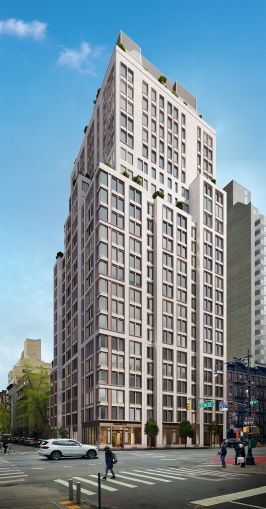
MAG Partners and Safanad have formed a joint venture with Global Holdings Group to capitalize their new 23-story, 194-unit, mixed-use luxury residential development at 300 East 50th Street in the Turtle Bay neighborhood of Midtown Manhattan, Commercial Observer has learned.
Bank OZK (OZK) provided a $95 million construction loan for the $200 million development.
JLL Capital Markets secured both the equity and construction financing for the deal. The JLL debt advisory team was led by Geoff Goldstein and Jillian Mariutti, and Stephen Van Leer. The JLL sales and equity team was led by Rob Hinckley and Jeff Julien and Nicco Lupo.
MaryAnne Gilmartin, CEO and founder of MAG Partners, noted that the deal builds on two other multifamily projects her firm has recently developed in Manhattan: 243 West 28th Street, which launched leasing in March, and 335 Eighth Avenue, which broke ground in October.
“The capitalization of 300 East 50th Street with a partner like Global Holdings is another massive milestone and proof point for our multifamily approach,” said Gilmartin in a statement. “We are excited to deliver this beautifully designed addition to the neighborhood.”
Eyal Ofer, chairman of Global Holdings Group, called 300 East 50th Street “the perfect addition” to the firm’s growing portfolio of luxury, condo-quality rental housing in Manhattan, which includes Anagram Columbus Circle, a Columbus Circle development that opened leasing in July.
“This project is another opportunity to bring experience from our pioneering condo developments like 15 Central Park West and the Greenwich Lane to the multifamily market,” Ofer said in a statement.
The new development will sit in the affluent Turtle Bay neighborhood of Midtown Manhattan, a small hamlet of mid-20th century buildings just off the East River and near the Queensboro Bridge.
300 East 50th will feature more than 142,000 square feet of residential space across nearly 200 units and include approximately 4,888 square feet of retail space. Unit sizes will range from one- to three-bedroom apartments, while building amenities will include a courtyard, a rooftop garden, a coworking lounge, a fitness center, a pet spa and individual tenant storage.
This is yet another deal between MAG Partners and Safanad, companies that had previously formed a joint venture agreement centered around New York metropolitan area acquisitions. The project is also one of the last in the city to be developed using the Affordable New York tax incentive program, more commonly known as 421a.
Affordable New York requires at least 30 percent of units in a new development be affordable for low- to middle-income New Yorkers.
“Safanad is proud of the partnership’s work to capitalize the 50th Street deal in the face of an extremely challenging capital markets environment,” said Danny Jumblatt, managing director, Safanad, in a statement. “We are confident in the project’s success given the continued robust demand for new rental product in Manhattan and the favorable supply backdrop given the expiration of the 421a program.”
Construction is expected to be completed in the fourth quarter of 2025.
Next up for Baltimore Peninsula’s food and drink roster: a coffee shop
By: Amanda Yeager
Baltimore Peninsula, the new neighborhood in the works on the South Baltimore waterfront, so far has a hotel, office buildings, apartments, a distillery and two restaurants. As we learned last week, two more eateries — vegan restaurants from Baltimore native and Slutty Vegan CEO Pinky Cole — are on the way in 2024.
What it doesn’t have is a place to grab a coffee. That will change early next year, the project’s developers said Friday.
The neighborhood’s Roost hotel will open a coffee shop and provisions store in the spring. The yet-to-be-named business will serve espresso drinks and grab-and-go goods like pastries and prepared foods, said the hotel’s president, Daniel Cruz.
“We’re one of the first businesses to open in Baltimore Peninsula, and having this coffee and provisions store is really going to help activate the building,” Cruz said.
The 81-room Roost hotel, which offers apartment-style lodging for short-term and extended stays, opened in July. The building also houses 40 apartment units for long-term tenants.
Roost’s parent company, Method Co., will operate the coffee and provisions shop, which will also offer dry goods, home goods and local produce for sale. Cruz said the company hopes to source products from local vendors. A rendering of the 600-square-foot store shows a rustic-looking space with patterned tile floors, communal table and lots of hanging plants.
Cruz said the coffee shop will have seating of its own and will connect to the hotel lobby, where there is more seating available to guests. The store will be open to the public.
The cafe is the latest food-and-drink concept slated for the Baltimore Peninsula, formerly known as Port Covington. The 235-acre redevelopment of once-industrial land is also home to Nick’s Fish House, the Sagamore Spirit distillery and Rye Street Tavern, which will reopen in the new year under new management. Cole will bring plant-based burger chain Slutty Vegan and a cocktail bar and restaurant called Bar Vegan to the Rye Street Market building by the fourth quarter of 2024.
Baltimore native Pinky Cole finally brings Slutty Vegan home: ‘I was always a winner’
By: Matti Gellman
Slutty Vegan founder Pinky Cole announced Thursday that she is opening a location at Baltimore Peninsula. (Kylie Cooper/The Baltimore Banner)
No one is less surprised by the success of the growing plant-based food chain and soon-to-be main attraction for the new Baltimore Peninsula neighborhood than its founder: Baltimore native Pinky Cole.
Slutty Vegan, her restaurant, as well as its companion Bar Vegan, is scheduled to open in the Rye Street Market, a boutique office space within the Baltimore Peninsula neighborhood (formerly known as Port Covington). It joins the company’s other eateries in Georgia, Texas, Alabama and New York.
She sat down with The Baltimore Banner on Thursday, clutching the baby bump protruding from her satin leopard dress, to discuss the announcement before a news conference featuring a performance from Morgan State University’s marching band and remarks from Mayor Brandon Scott. Behind her lay at least a dozen untouched copies of her “I Hope You Fail” memoir. Its early October release had prompted a Wednesday visit to “The Kelly Clarkson Show,” which, Cole noted, was not her first time as a guest there.
Slutty Vegan’s success left many at the event inspired, including one resident who walked up to Cole crying Thursday to express his gratitude, she said. Some have called her a “young Oprah,” according to Cole — a comparison she’s never shied away from.
“I knew as a kid that I was going to be great in the world,” said Cole, 35. “I was always a winner. I always had a winning mentality and that didn’t die.”
Pinky Cole cries while talking about Baltimore’s impact on her life as Mayor Brandon Scott and Councilwoman Phylicia Porter look on at an event for Slutty Vegan on Thursday. (Kylie Cooper/The Baltimore Banner)Slutty Vegan’s “Sloppy Toppy” burger is topped with jalapeños, vegan cheese, onions, lettuce, tomato and “Slut Sauce.” (Kylie Cooper/The Baltimore Banner)
Cole’s business, now valued around $100 million, was built on her flair for the theatrical. Growing up on Cedonia Avenue in East Baltimore, she learned about stocks and business practices from her father, who had been incarcerated during her childhood.
The only person able to compete with Cole for the spotlight was her mother, the lead singer of a local reggae band called Strikers Posse. Ichelle Cole, a native of Jamaica, spent nights center stage in locs that touched the floor, singing and playing “nearly every instrument,” according to her daughter.
When the Posse went to Ocean City, so did Cole. She often joined her mother in the spotlight.
“I would see these crowds of people and I saw how many people loved my mother and I’m like, ‘I want people to love me like that, too,’” Cole said.
She took on her mother’s Rastafarian diet of fresh produce and some fish. But by 2007, Cole cut out meat entirely. She cooked vegan food for her friends, though Cole is the first to admit she was never a chef. In her early 20s, she used the money she made working as a television producer on the Maury Povich show to start a bubblegum pink-painted, Jamaican-inspired storefront in Harlem, New York.
About a year after opening in 2015, the restaurant burned down in a grease fire.
“People never talk about failure,” Cole said. “It’s inevitable. Like, life happens. … And I want people to know you don’t have to wallow in negativity.”
Success came for Cole in 2020, when she capitalized on her love of a plant-based diet and created the first iteration of Slutty Vegan, which she called a “merge between the two most pleasurable experiences in life: sex and food.”
Interested converts could choose plant-based burgers slathered in the usual condiments and vegan cheese, otherwise known as a “Sloppy Toppy,” or sandwiches like the “Hollywood Hooker,” a seductive twist on a classic Philly cheesesteak.
“I knew I had to get people dialed in, so that they can spark a dialogue and start to ask questions. And if I can get people to ask questions, that means that I can educate them on whatever it is I want to teach them,” she said.
And that was vegan food. She got pushback in the beginning, she said, but saw her business spurring conversation about the way customers eat and respond to marketing.
Slutty Vegan founder Pinky Cole’s necklace gets straight to the point. (Kylie Cooper/The Baltimore Banner)
Whispers of Cole’s return to Charm City have hung over the Baltimore food world since the company’s infancy. In December 2022, Cole said she’s “gotta come back home” in an interview recorded with the radio station 92Q. In March of the following year, she tested the Chesapeake Bay waters with a pop-up store at Hampden’s Whitehall Mill. Lines of hungry people wrapped around the building.
“Who knows, if we run out of burgers we may just have to open a location here,” she previously said in an interview with The Baltimore Sun.
Cole said she remains optimistic about the growth of her Slutty Vegan chain despite a volatile year in the restaurant and vegan food industry.
She told The Baltimore Banner her business recently won a bid to open a location in the Hartsfield-Jackson Atlanta International Airport, the busiest airport in the country by passenger traffic. Slutty Vegan is also looking into licensing the brand overseas.
“My husband … he’ll be the guinea pig,” she said of Derrick Hayes, founder and CEO of Big Dave’s Cheesesteaks.
”But right now, the main focus is the Baltimore Peninsula,” Cole said. She indicated that plans to move into Northwood Commons, which previously listed Slutty Vegan as one of their new tenants over Instagram, were not currently in the works.
”I like new things. I like new fresh things,” she said. “There’s a big opportunity to be able to drive a new audience to this area.”
Cole said another draw was learning that more than half the employees hired to work on the Baltimore Peninsula’s $5.5 million development effort would be Baltimore residents.
MaryAnne Gilmartin, founder of MAG Partners, a New York firm leading the project, said Cole’s arrival as the anchor tenant in Rye Street Market will help drive traffic to the neighborhood.
According to Gilmartin, developers are expecting more residents and local businesses to move in after Cole, including a potential grocer; there is no grocery store within the community’s largely industrial 235 square acres.
“This is about real people, making real impact and delivering real change and lifting up entire communities,” Gilmartin said. “[Pinky Cole] is the embodiment of what this project represents.”
Baltimore native Pinky Cole will bring her Slutty Vegan, Bar Vegan restaurants to Baltimore Peninsula in 2024
By: Amanda Yeager
Slutty Vegan, the Atlanta-based burger chain with Baltimore roots, will touch down in the Baltimore Peninsula next year.
Baltimore native Pinky Cole will open new locations of her popular vegan burger chain, Slutty Vegan, and Bar Vegan, a plant-based restaurant and cocktail spot, in Baltimore Peninsula’s Rye Street Market building next year. (Baltimore Peninsula)
Founder Aisha “Pinky” Cole plans to open a location of her uber-popular vegan restaurant in the Rye Street Market, one of five new buildings that have recently cropped up on the 235-acre South Baltimore development site, formerly known as Port Covington. She will also open a new location of Bar Vegan, a sit-down spot serving cocktails and plant-based versions of dishes like tacos and linguine.
Cole was alongside Mayor Brandon M. Scott and officials from the Baltimore Peninsula’s development team Oct. 26 to announce the latest expansion of her vegan empire, valued at $100 million. The Baltimore native, a graduate of Western High School, launched Slutty Vegan five years ago in Atlanta, where she earned a degree in mass marketing and communications from Clark Atlanta University.
The Baltimore Peninsula restaurants represent a “homecoming” for Cole, who drew hundreds of people to a Slutty Vegan food truck pop-up in Hampden last year and hundreds more to an appearance at Baltimore Soundstage in December promoting her new cookbook, “Eat Plants, B*tch.”
“We are going to take over Baltimore in a way that we’ve never done before,” she said.
Both restaurants are expected to open by the fourth quarter of 2024. Cole will be a development partner in the project; she and officials from developer MAG Partners declined to disclose the specifics of the deal but said she will promote and profit from the development beyond her two restaurants.
“It’s not a typical real estate transaction,” said MaryAnne Gilmartin, founder and CEO of MAG Partners, the New York-based development firm that is spearheading the project along with developer MacFarlane Partners. “This project is about impact, it’s about building community and it’s about Baltimore, and she is all of those things. In Rye Street Market, we have an understanding that she will benefit from success in the building that goes beyond the success of her individual restaurants.”
Cole also has plans to open a location of Slutty Vegan in the Northwood Commons development near Morgan State University. The retail center shared the news on Instagram in August. In an interview, she said she still intends to open the Northeast Baltimore location though does not have a timeframe for when that will happen.
The bulk of restaurants in the Slutty Vegan chain have so far been centralized in the Atlanta area, with other locations in Alabama, Texas and New York City. Cole said she recently closed a deal to open a Slutty Vegan outpost at the Hartsfield-Jackson Atlanta International Airport.
At Rye Street Market, Cole’s restaurants will have a prime corner location with views of the Sagamore Spirit distillery and the waterfront. Slutty Vegan will have a fast-casual setup featuring a menu of vegan patties with provocative names like “One Night Stand” and “Ménage a Trois.” (Cole told the Sun in December that she picked the “Slutty Vegan” name in a deliberate effort to generate buzz. “I knew if I named it ‘Pinky’s Vegan,’ nobody was coming,” she said. “But if I named it Slutty Vegan, people would react.”)
Bar Vegan, meanwhile, will be “like the big sister that’s a little more sophisticated and mature,” Cole said. The restaurant, which has another location in Atlanta’s Ponce City Market, serves vegan tacos, pasta and sandwiches as well as cocktails. Cole said the space will encourage diners to stick around with live performances and TVs screening sports games. Together, Slutty Vegan and Bar Vegan are expected to create about 100 jobs.
The pair of restaurants are the first retail tenants to be announced for the Rye Street Market, a 275,000-square-foot building that houses offices as well as 38,000 square feet dedicated to retail. Developers are looking to fill the space with a mix of local and national tenants, Gilmartin said.
Other recent construction at the Baltimore Peninsula includes two office buildings with spaces leased so far to CFG Bank and the H. Chambers Co. design firm, as well as two residential buildings, Rye House and 250 Mission, which began leasing this spring. A Roost hotel opened in July, and Rye Street Tavern, a waterfront restaurant, is slated to reopen early next year under the management of Washington, D.C.-based Clyde’s Restaurant Group.
Cole joined the Baltimore Peninsula project after a member of her management team, KD McNair, connected her with developers there. She met with Kevin Plank, the Under Armour founder and a driving force behind the Baltimore Peninsula project via his Sagamore Ventures investment firm.
“I’ve followed his career for a while,” Cole said. “We realized that coming together would be a big win for the city, especially because I’m from Baltimore.”
Plank, who started buying up land for the redevelopment about a decade ago, said Cole was “bringing that Baltimore grit back home for us” with the opening of her Baltimore Peninsula restaurants.
“When I first met Pinky, I knew immediately that she was the right partner for the project,” he said at the Oct. 26 announcement, before addressing Cole. “What you mean is so much more than another lease opening in a group of buildings. This is another cornerstone in our amazing city that we are going to build.”
The homecoming announcement was accompanied by an upbeat performance from Morgan State University’s marching band, confetti and free Slutty Vegan burgers.
Cole said she hopes her expansion to Baltimore will inspire other entrepreneurs.
“I have been promoting Baltimore since the beginning,” she said, “so when people see all the accolades and accomplishments, it’s not just a win to me, it’s a win for the city. I would love for people to say, ‘Pinky achieved it, I can too.’”
Baltimore native Pinky Cole (pictured in 2022) is the founder of Slutty Vegan plant-based burger chain. (Karl Merton Ferron/The Baltimore Sun)
Aisha ‘Pinky’ Cole to bring Slutty Vegan, Bar Vegan restaurants to Baltimore
By: Morgan Simpson
Aisha “Pinky” Cole will bring two of her popular vegan restaurants to the city next year, the Baltimore native said Thursday during an event in South Baltimore that included the Morgan State University marching band and a slew of local dignitaries.
In what could be a Baltimore first, communities and developer are partnering in South Baltimore
By: Jasmine Vaughn-Hall and Hallie Miller
The coalition has formed a nonprofit that is in charge of overseeing how a momentous volume of funding gets spent in South Baltimore.
Views of CSX facilities scene from the Curtis Bay neighborhood in Baltimore, Thursday, August 3, 2023. (Jessica Gallagher/The Baltimore Banner)
Growing up in South Baltimore, Michael Middleton became accustomed to the invisible barriers separating his neighborhood from the next one over. Those imaginary lines, he recalled, meant that Cherry Hill and Brooklyn neighbors shared little in common besides geography.
Now retired, Middleton said something extraordinary has happened to those walls over the last few years. Six South Baltimore communities, wary of development north of the Patapsco River’s Middle Branch, joined forces nearly a decade ago and turned a page. Together, they and the developers leading Port Covington’s revival have built relationships, convened to discuss shared problems and formed a nonprofit organization and board to handle a momentous influx of money they can put to use in their communities however they see fit.
The nonprofit, SB7 Coalition Inc. — representing Cherry Hill, Brooklyn, Mount Winans, Lakeland, Westport, Curtis Bay and their Baltimore Peninsula partners — is set to receive more than $20 million by 2026. With that historic investment, the nonprofit organization and the residents it serves are tasked with something both novel and daunting: using the money to fill in the gaps left behind by generations of neglect.
The needs in the six communities are varied and vast, ranging from dire environmental threats to an over concentration of vacant and abandoned housing. And now, representatives across six very different neighborhoods — many of them volunteers or brand new to grant writing, community organizing and managing large sums of social-impact funds — say they are starting to see the first fruits of their efforts bloom.
“For decades, the communities really didn’t have much to do with one another. The most significant thing that has happened is that we have come together now,” said Middleton, a former poverty law attorney who now leads the South Baltimore nonprofit organization. “And the six communities recognize that we have more in common than we have differences.”
The ways by which the funding is divided, allocated and spent are complex: The coalition has devised a multi-tier system that appropriates some of the money for individual community organizations in each neighborhood; some for broad priorities such as transportation, public safety and education; and some for recipients whose work directly impacts the South Baltimore area.
Middleton, who formerly led the Cherry Hill Community Coalition, is first to acknowledge that the $20 million investment can only go so far.
But it’s a start, he said, that can set these communities up to be more prosperous and effective in the long run. And for what could be the first time in the city’s history, a private developer and a group of community members are banding together to see the work through.
Greg Sawtell, Chenire Carter, Michael Middleton, Ashley Cotton and Lindsay Staton pose for a portrait outside of the SB7 coalition’s future office space in Baltimore, Friday, Sept. 29, 2023. (Jessica Gallagher/The Baltimore Banner)
A long-term commitment to South Baltimore communities
The six communities once housed the workforces of South Baltimore’s industrial past. Over the last few decades, fueled by manufacturing’s exodus, the community demographics have changed. And from 2010 to 2020 alone, the population decreased by about 5%, city Department of Planning data shows. The Latino population more than doubled over that same period.
And now, the first Baltimore Peninsula residential and office tenants are trickling in. The more than $5.5 billion project — funded partly with some $660 million in tax-increment financing from the city, the largest such package to date — is expected to bring millions of square feet of office, retail, residential and public park space spanning 235 acres of mostly barren and industrial waterfront land. It will contain the new headquarters of sports apparel giant Under Armour, whose founder, Kevin Plank, began buying up the land about a decade ago.
SB7 was formed largely as a response to skepticism about what effect a project of this scope and scale would have on its residential neighbors. Though it involves no direct displacement of businesses or residents, some neighborhood leaders have raised concerns about being priced out of their homes, excluded from incoming investment and ignored in favor of a new “mini-city.”
While some of these concerns still exist, those involved in the nonprofit’s work say they are building lines of communication, collaboration and change that they have long gone without.
“So many things are starting to get attention — multi-decade-long priorities that didn’t get done because there were no resources,” said Greg Sawtell, an SB7 board member and co-president of the Curtis Bay Association. “The outcomes aren’t there yet, but it’s a process. The structure is there.”
At the center of the community benefits agreement is a multimillion-dollar commitment to the six neighborhoods from Sagamore Development Co., Plank’s development arm. That includes a direct $10 million disbursement over the first five years and a commitment from Sagamore Ventures to help the coalition raise another $10 million over the following five years, according to the 2016 agreement.
The deal also includes a requirement from Sagamore and the other Baltimore Peninsula developers to contribute funds from a portion of every new lease signed to SB7 — a minimum of 15 cents per net square foot — and a portion of every transfer fee per property sale. Sagamore Ventures has also donated $1 million to Baltimore’s CollegeBound Foundation and $1 million to Partners in Excellence for local students’ scholarships.
How has the rest of the money been spent so far?
The 10-page agreement does not dictate how the community entities or the SB7 nonprofit should use the funds, but it does offer a list of short- and long-term priorities that the coalition should address over the next 30 years. They include one-time expenditures on items such as athletic fields and community centers, and it gives examples of needs such as cemetery maintenance, funding for youth development and recreational programming.
“They know what they want in their communities, but may need guidance and/or resources to bring their aspirations to fruition,” said Marc Weller, the president and founding partner of Weller Development Partners, who led development of the project’s first phase. Weller’s team served as advisers to the group from 2016 until 2022, when a new development team, MAG Partners, took the reins.
“It was purposely designed that way so that they could control their own destiny, future, and decisions,” he added. “Our philosophy has always emphasized the importance of community interaction, and frankly, it is just the right way to do business.”
Mark Pollak, a partner at Ballard Spahr LLP who represents the Baltimore Peninsula developers and helped negotiate the 2016 agreement, said the coalition may well be the first of its kind in Baltimore.
“There were no models from which we took our ideas from,” he said in an email. “We believe the partnership is a successful model that represents what can happen when the City and a development team believe in the ability of a project, in collaboration with community members, to deliver unprecedented benefits to the City.”
How they’ll pick projects
The structure through which money flows to communities is a complicated one — so much so that, during an interview with reporters earlier this year, SB7 board members — including representatives from MAG Partners — came prepared with thick, stapled packets of paper they could refer to.
Here’s how it works: To start, each of the six community organizations receives $200,000 apiece to help them grow. The money might be used to secure designated meeting space, add paid staff or apply for nonprofit status.
On another tier of the funding system, six committees — devoted to organizing around solutions for education, public safety, quality of life/zero waste, transportation, economic development and community land trust — can propose projects that can have impact in at least two or more of the six communities. Those proposals must address concerns laid out in SB7′s strategic plan and are reviewed by committees, the nonprofit’s appropriations committee and then the board for approval.
And finally, community association review panels can award grants of up to $2,500 at a time to individuals or organizations already active in the area to further their work or fund new projects. These recipients include the Black Yield Institute, the Baltimore Compost Collective and the South Baltimore Community Land Trust. Each community receives $50,000 to spend.
Coalition members said they rely on their communities to identify challenges they face and how to solve them. But not everyone always agrees on every expenditure and priority,which can spark debate and occasional infighting, the SB7 representatives said.
“I don’t think you’re going to find authentic governance without potential conflict, and it’s that process that gets to some of our best outcomes,” said Sawtell of the Curtis Bay Association.
‘It’s a lot of money’
Out in the communities, SB7 members say their work touches upon a spectrum of needs identified in their neighborhoods: cleaning and greening, older adult programming, health and wellness.
For example, some of the funds have gone toward commemorating a 100-year-old firehouse in Curtis Bay and helping the Baltimore Animal Rescue and Care Shelter with chipping and vaccination services in Brooklyn and Cherry Hill.
Community members also said the larger community grant awards, meanwhile, have presented new opportunities to collaborate on projects and ideas.
One such proposal — a transportation initiative — is funding church vans that can be used by the South Baltimore nonprofit City of Refuge to shuttle residents around who may not have other modes of transit available. Another allowed the SB7 nonprofit to purchase a former Brooklyn dental clinic that will be converted into community meeting space.
The South Baltimore Environmental Justice Collaborative is another such combination of efforts. Students Carlos Sanchez, Taysia Thompson and Vilma Gutierrez are on a small team that’s collecting data that tracks environmental outcomes for neighborhoods close to the CSX Coal Terminal in Curtis Bay, where methane gas that built up in a tunnel exploded in Dec. 2021.
“We’re the next up-and-coming generation to fix the problem that’s been broken for many years,” Thompson said.
From left: Taysia Thompson, Vilma Gutierrez and Carlos Sanchez pose for a portrait outside of the CSX Facility in Curtis Bay on Aug. 4, 2023. (Ulysses Muñoz/The Baltimore Banner)
LETS GO Boys and Girls, a nonprofit that promotes equitable access to STEM learning, was given a grant to provide coaching, training, mentoring and materials in Westport, Cherry Hill, Brooklyn and Lakeland.
In Brooklyn, funds to strengthen the community association still haven’t been distributed, but that’s because Concerned Citizens for a Better Brooklyn is solidifying its budget. Andrea Mayer, co-chair of Concerned Citizens for a Better Brooklyn, said they’ve changed the budget a few times as they’ve decided on different programs and partnerships they want to pursue in the community.
“We were struggling because it’s a lot of money and we wanted to be wise in how we spend it,” Mayer said. She said they’re considering hiring staff to help run the community association.
In Mount Winans, Angela Smothers, president of the community association, surveyed residents door to door in 2021. There were two consistent asks, she said: a community center and more activities for seniors and kids. She plans on using funds for a playground, walking trails and exercise equipment on South Paca Street.
“As opposed to saying, ‘This is what I want or this is what we need,’ I asked, what would be the thing they’d like to see happen?” Smothers said. “They were losing interest because it has been so long, promises that were made were ignored.”
For Keisha Allen, the Westport Neighborhood Association president and chairperson of the Westport Community Development Corporation, a benefit of the SB7 funds is its flexibility to be infused into existing projects. The Westport CDC, for example, owns 17 houses that will eventually be transformed into affordable housing units, and SB7 money is augmenting that work.
Other coalition funds are supporting Westport’s “green ambassador” program, which pays people to take on beautification work such as trash pickup, lawn mowing and tree pruning, she said.
Allen, who recalled feeling skeptical about the plans for Baltimore Peninsula initially, said her feelings have warmed and softened over time.
“We’re no dummies; we saw a threat, and we saw what could happen,” she said about the coalition forming. “It was making sure we weren’t being mistreated or pushed out of our homes.”
Allen said she has high hopes, especially about the brick-and-mortar headquarters in Brooklyn that coalition members will be able to use for meetings, classes and other in-person gatherings. She thinks the physical space could inspire younger people to get involved and make connections. And maybe, she said, it will attract more visits and attention about the coalition’s groundbreaking work.
“Look at what we did, and how we came about, and what we’re doing,” she said. “I don’t see the same enthusiasm in the same way they get enthusiastic about things in other parts of the city.”
Mixed-income apartments set to break ground in Chelsea
By: Kevin Smith
Construction on a new New York City apartment building is about to start in Manhattan’s Chelsea neighborhood. Developer MAG Partners, affordable housing co-op Penn South and investment firm Safanad will host a groundbreaking on Tuesday for a seven-story mixed-use apartment building at 335 Eighth Ave. Demolition on the structure began earlier this summer.
Construction is expected to be finished in 2026. Lidl Grocery store is planned to be the ground-floor tenant.
The project will provide 188 units. Architecture firm CookFox designed the building. About 30% of the apartments, or about 57 units, will be reserved for low- and middle income New York households.
The area median income for “low-income” New York households is considered between 51% and 80% For example, the income range of households of one to three people starts between $49,450 and $63,550, respectively, according to the New York City Department Housing Preservation and Development.
“Moderate-income” New York households, which sit between low-income and middle income, make between 81% to 120% of the area median income.
And “middle-income” New York households make between 121% and 165% of the area median income. Their range of income starts at about $120,000 for a single-person households and about $155,000 for a household of three people. That range ends at more than $163,000 for single-person households and $210,000 for households of three.
The groundbreaking will feature several speakers from the development partners: Ambur Nicosia, president of the Penn South Co-op Board, MaryAnne Gilmartin, founder and CEO of MAG Partners, and Andrew Trickett, partner and head of investment at Safanad.
Construction Begins At 335 Eighth Avenue In Chelsea, Manhattan
By: SEBASTIAN MORRIS
A mixed-use development at 335 Eighth Avenue in Chelsea, Manhattan has officially broken ground. The project is the latest development from MAG Partners and global holding company Safanad, who’ve retained COOKFOX Architects to design the property and Urban Atelier Group as general contractor.
The structure will top out at seven stories and comprise around 200,000 square feet. When complete, the building will have a 23,000-square-foot Lidl supermarket, 188 rental units, and additional ground-floor retail spaces. Thirty percent of the apartment stock will be reserved for low- and middle-income residents.
Renderings of the property show a handsome red brick facade, a standard punched window system, and several setbacks that make room for private and communal outdoor spaces.
“Our investments with MAG Partners demonstrate our conviction in the strength of the New York City multifamily market,” said Danny Jumblatt, managing director at Safanad. “We look forward to building on the success of the Ruby with the 8th Avenue site, which we believe will bring further high-quality rental products to an attractive submarket.”
The project team has not announced an anticipated date of completion.
Work Starts On Affordable Housing, Lidl Supermarket In Chelsea
By: Emily Rahhal
The new 188-unit property will help Penn South protect its affordable housing developments.
CHELSEA, NY — Work started Tuesday on a 188-unit development that will include affordable housing and a Lidl Supermarket — developed in tandem with a co-op that protects affordable units with a profit-limiting model.
Some 30 percent of units in the development, which sits at West 26th Street near 8th Avenue, will be affordable housing rentals, and the rest will be rented at market-rate, according to developers MAG Partners. The project is expected to be complete in 2025.
“Let’s take a moment to think about what this is going to mean to the 57 families who get to live in this building. Many of whom right now are living in our shelter system,” City Council Member Erik Bottcher said at Tuesday’s groundbreaking.
“Let’s recreate that hundreds of times, thousands of times.”
A 23,000-square-foot Lidl supermarket and ground-level retail space will replace what used to be a McDonald’s and Gristedes.
The seven-story building sits near Penn South, an affordable housing co-op including 15 buildings that protects affordable units by limiting owner profits on property resale. The buildings all sit between Eighth and Ninth Avenues from 23rd Street to 29th Streets.
“There is no profit on the sale of apartments; when cooperators leave Penn South, they are entitled to a return of the equity that they paid,” the co-op wrote on its website.
The profits from this new development will help Penn South maintain its other properties’ affordability.
“Home to nearly 5,000 New Yorkers, Penn South is a beacon of access and equity in the heart of Manhattan, — and it will stay that way, thanks to the project we’re celebrating today,” said Ambur Nicosia, Penn South Board President, in a statement.
Electeds celebrated the groundbreaking as a model for affordable housing across the city.
“Let’s go out and do this again and again and again,” Bottcher said.
Construction Begins on a New Mixed-Use Building at 335 Eighth Ave.
By: CHIA-TIEN NICOLE CHEN
The development will bring 188 new apartments—56 of which will be income-restricted — and a Lidl grocery store in fall 2025.
On Tuesday, Oct. 3, developers broke ground on a new mixed-used building at 335 Eighth Ave., which is slated to bring to the neighborhood 188 residential units—30 percent of which will be reserved for low- and middle-income tenants—and a new Lidl grocery store.
The seven-story, 200,000 square-foot building, developed by real estate company MAG Partners, will be located at the corner of Eighth Avenue and West 26th Street—near the affordable co-op Penn South’s 15-building complex. It will be MAG Partners’ second multi-family development in Manhattan, after Ruby on 243 W. 28th St. The project is co-financed by the investment firm Safanad, and is developed with the Affordable Housing New York program, otherwise known as the 421a tax break.
The Eighth Avenue lot formerly hosted a deteriorating, Penn-South-owned commercial building with a Gristedes, McDonald’s, and tennis club on the ground floor. Unable to afford the cost of repairs and facing the expiration of commercial tenants’ leases, Penn South voted to lease out the site for redevelopment. They selected MAG Partners in 2021.
MAG Partners signed the 99-year ground lease in December of 2022, according to city records. Rent paid to Penn South will go toward subsidizing the Mitchell-Lama co-op’s 2,820 apartments, maintaining affordability for its residents. For MAG Partners, annual rent will begin at $2 million and increase over the length of the lease, totaling at around $750 million for Penn South, sources told the Real Deal.
Design for the new building “matches neighborhood context, mirroring and updating the redbrick aesthetic of the Penn South towers,” says a press release from MAG Partners. It will also integrate passive-house design, planted courtyards, and terraces, according to Rick Cook, Founding Partner of COOKFOX, the architecture firm on the project.
Demolition of the old building on the site was completed in September. The development’s groundbreaking ceremony took place on Tuesday, Oct. 3.



:quality(70)/cloudfront-us-east-1.images.arcpublishing.com/baltimorebanner/SU3VVCMI3NF4TIW6PCGJERJO64.jpg)
:quality(70)/cloudfront-us-east-1.images.arcpublishing.com/baltimorebanner/K2VOP23PPJBJ7E2VMDF62K2ZRI.jpg)
:quality(70)/cloudfront-us-east-1.images.arcpublishing.com/baltimorebanner/TZRDKMXJRVF6JLIOFIZ7RJYNCM.jpg)
:quality(70)/cloudfront-us-east-1.images.arcpublishing.com/baltimorebanner/DUOW4OMENRG4HPTTR2536EK3AE.jpg)


:quality(70)/cloudfront-us-east-1.images.arcpublishing.com/baltimorebanner/573XPLSNSZFI7DOZTVU5DMTREE.JPG)
:quality(70)/cloudfront-us-east-1.images.arcpublishing.com/baltimorebanner/QIJRYSBVCJBP3GNMFQMHROUU6A.JPG)
:quality(70)/cloudfront-us-east-1.images.arcpublishing.com/baltimorebanner/CWAG2XYOWVGMFHCHTESPNH4QTQ.jpg)


