January 5, 2023

CFG Bank Signs Lease at Baltimore Peninsula Becoming Newest Commercial Tenant Holding Largest Lease to Date

CFG Bank to Move to the South Baltimore Development in Q4 2023, Leasing 97,000 Square Feet of Office Space

Today, the Baltimore Peninsula development team, led by MAG Partners and MacFarlane Partners, and CFG Bank, announced that CFG Bank has signed a long-term lease for three floors, totaling 97,000 square feet of office space in 2455 House Street in Baltimore Peninsula. CFG Bank is the development’s latest confirmed commercial tenant, signing a 15-year lease at the 235-acre mixed-use development. 2455 House Street will serve as the headquarters for CFG Bank, as well as Capital Funding Group and the Jack and Nancy Dwyer Workforce Development Center, Inc.

The lease signing comes as the development’s first phase of vertical construction nears completion, with over 1.1 million square feet of new office, retail, and mixed-income residential opening in 2023. It is also the first commercial lease signing since the project rebranded in November 2022 to Baltimore Peninsula and is part of the larger effort to realize the development as a vibrant mixed-income residential neighborhood and thriving business district, supported by waterfront events and activities, new restaurants and social destinations that bring opportunity and strengthen the spirit of Baltimore. 

Along with MAG Partners, CFG Bank is working with NewGround to create its one-of-a-kind headquarters. The office spaces will feature various indoor and outdoor collaboration areas with an employee lounge totaling 5,000 square feet, a rooftop community space, a library area, robust kitchens, an indoor sports simulator, and more. 

“The partnership with CFG Bank represents our shared values and commitment to fostering a strong, inclusive community. It speaks volumes that a company like CFG Bank, a pillar of the Baltimore business community, has selected Baltimore Peninsula for its future home,” said Kevin Plank, Principal and CEO of Sagamore Ventures. “I am incredibly proud to welcome CFG Bank and look forward to working together to build on our vision of impact at Baltimore Peninsula.”

“We are excited to continue to welcome new tenants to Baltimore Peninsula, especially those like CFG Bank who have strong, established roots within the broader Baltimore community,” said Michael Lohr, Managing Director, Goldman Sachs Asset Management. “This lease represents another key milestone toward our broader revitalization efforts in South Baltimore, which seeks to engage the community through job creation and workforce development, in addition to providing access to new attractions and events.”

“Our lease with CFG Bank marks the beginning of an exciting partnership for Baltimore Peninsula, as the Baltimore-based institution grows its workforce in and for the city. With buy-in from partners such as CFG, we are building a place where people want to live and work,” said MaryAnne Gilmartin, Founder and CEO of MAG Partners. “We have incredible momentum and interest from potential tenants in Baltimore and around the country and expect to have a number of leases to announce in the coming months as we move closer to construction completion for the first phase of the project.”

“We’re thrilled to be moving our headquarters to Baltimore Peninsula. As our businesses continued to grow, we were in search of a new location that could accommodate our current and future expansion, provide an environment to foster our team’s entrepreneurial spirit, and support the reinvigoration of Baltimore,” said CFG Bank CEO & President Bill Wiedel. “As we design and build our new headquarters, we are creating a truly unique space where all our employees will thrive and work together, grow, and achieve our own goals and those of our clients. Our plan is to design a special workspace where our employees want to come into the office. Moving to Baltimore Peninsula reinforces our commitment to Baltimore and our leadership position in the banking industry, as the largest bank headquartered in Baltimore.”

“We always knew that Baltimore would be a ‘build it and they will come’ office market, and now that the buildings are delivering you are seeing that dynamic play out,” said Marc Weller, Founding Partner and President at Weller Development Partners. “Since first introducing CFG Bank to the project, we always thought they would be a great fit given their aligned entrepreneurial philosophy and their focus not only on transforming the banking experience but also their commitment to the community. We are so excited to see CFG Bank moving to this new burgeoning neighborhood.”

Scooter Monroe, Vice President of Office Leasing at MAG Partners, and real estate advisor Ed Guiltinan worked closely with the teams at JLL and Weller Development Partners to secure the lease. Antony Gross and Anne Marie Paintsil with JLL represented Baltimore Peninsula. Kevin Haus and Matt Haas, also with JLL, represented CFG Bank in the transaction. 

CFG Bank’s lease follows the September 2022 announcement that H. Chambers Company, an architecture and interior design firm, was the development’s first commercial tenant, having signed a long-term lease for 9,000 square feet of office space at Rye Street Market. Chambers will relocate to Baltimore Peninsula in March of 2023. Also in November 2022, the development team revealed Rye House and 250 Mission, comprising 416 brand-new affordable and market rate residences. Leasing will begin in the first quarter 2023 and the first residents of Baltimore Peninsula are expected to move in March. The project has 20% affordable housing on site, with 35 affordable units at 250 Mission for households earning 80% AMI and 54 affordable units at Rye House for households earning 50% of AMI. Additional information about Rye House and 250 Mission can be found at liveryehouse.com and live250mission.com, respectively. In January the team will launch the final building, 2400 Terrapin Way, which includes 121 residential units, of which 81 are extended stay.

Baltimore Peninsula development is expected to deliver robust community benefits to support Baltimore City and South Baltimore communities. To date, Baltimore Peninsula has committed more than $132 million in contracts to Baltimore City-certified Minority and Women Business Enterprise firms, exceeding its initial goals with 35 percent participation for MBEs and 13 percent for WBEs. In line with the project’s MWBE goals, the Baltimore Peninsula development team supported Baltimore-based MBE Conscious Venture Lab in raising $50 million for investment in local companies using innovation to create a more equitable society, specifically targeting MWBEs. 

In November 2022, Baltimore Peninsula launched a new partnership with Project JumpStart – a workforce development and job placement program – to implement its 15-week construction training program that will ultimately support the continued construction of Baltimore Peninsula. The partnership, which will support the education of up to 22 students, includes financial support by Sagamore Ventures. In addition, Baltimore Peninsula announced a new partnership with Sweeten – a software company known for bringing trust, transparency, and data-driven decision making to the construction industry. Together, the parties built a tool that expands Baltimore Peninsula’s MWBE contracting goals and achievements, creates greater transparency in the procurement process of MWBEs and helps development teams communicate the status of their projects with the community. 

For more information on Baltimore Peninsula, visit baltimorepeninsula.com or visit on InstagramFacebook and Twitter.

###

About Baltimore Peninsula

Baltimore Peninsula is a 235-acre redevelopment project located on Baltimore City’s prime waterfront, featuring investments from Sagamore Ventures and the Urban Investment Group within Goldman Sachs Asset Management. As one of the largest urban revitalization efforts in the United States, Baltimore Peninsula will have a fundamental and far-reaching impact on Baltimore’s future. At completion, this transformative project will include: up to 14 million square feet of new, mixed-use development; 2.5 miles of restored waterfront; and 40 acres of parks and green space. The Baltimore Peninsula redevelopment is expected to generate fresh opportunities for innovation and entrepreneurship for Baltimore City residents and its local workforce.

About the Goldman Sachs Asset Management Urban Investment Group (UIG)

Bringing together traditional and alternative investments, Goldman Sachs Asset Management provides clients around the world with a dedicated partnership and focus on long-term performance. As the primary investing area within Goldman Sachs (NYSE: GS), we deliver investment and advisory services for the world’s leading institutions, financial advisors and individuals, drawing from our deeply connected global network and tailored expert insights, across every region and market—overseeing more than $2 trillion in assets under supervision worldwide as of September 30, 2022. Driven by a passion for our clients’ performance, we seek to build long-term relationships based on conviction, sustainable outcomes, and shared success over time. Goldman Sachs Asset Management invests in the full spectrum of alternatives, including private equity, growth equity, private credit, real estate and infrastructure.  Established in 2001, the Urban Investment Group within Goldman Sachs Asset Management has committed over $14 billion through real estate projects, social enterprises and lending facilities for small businesses.

About MAG Partners

MAG Partners is a woman-owned, urban real estate company with decades of experience developing impactful, iconic, large-scale projects throughout New York City. Led by MaryAnne Gilmartin, together the MAG Partners team has successfully designed, built and operated over 7 million square feet of office, residential and mixed-use projects, including over 2,000 units of housing, with a total value of over $4.5 billion. The firm believes and has proven that principles of beauty, diversity and sustainability create lasting value.

About MacFarlane Partners

MacFarlane Partners is a real estate investment and development firm that acquires, develops and manages properties on behalf of some of the world’s largest pension plans and institutions as well as for its own account. Founded in 1987, the firm pioneered the urban investment concept among institutional real estate investment managers in the 1990s and today is a leading investor in and developer of properties that promote smart growth, urban revitalization, sustainability and equitable development in urban and high-density suburban areas nationwide. It is headquartered in San Francisco and operates a regional office in Los Angeles.

About Sagamore Ventures

Sagamore Ventures is a privately-held investment company with diversified holdings that include commercial real estate, hospitality, food and beverage, and venture capital. The company is based in Baltimore, MD, and serves as the family office of Kevin A. Plank, the founder, Executive Chairman, and Brand Chief of Under Armour, Inc. Key investment holdings include Sagamore Spirit and a major equity stake in the Baltimore Peninsula redevelopment in South Baltimore.  The mission of Sagamore Ventures is to execute the initiatives of the Plank Family, support the growth of our investments, and contribute to economic development and opportunity in Baltimore City.

About CFG Bank (http://www.CFG.bank)

CFG Bank, headquartered in Baltimore, Maryland, is a full-service bank that provides premier commercial, personal, and online banking solutions to the Mid-Atlantic business community, national cannabis industry and national healthcare market. Locally owned and operated, CFG Bank transforms the banking experience by delivering big bank capabilities and expertise, coupled with relationship-driven boutique bank service. CFG Bank has branches in Lutherville and Baltimore City, and a commercial office in Annapolis. For more information, visit www.CFG.bank, and follow CFG Bank on LinkedInFacebook and Twitter

About JLL 

JLL (NYSE: JLL) is a leading professional services firm that specializes in real estate and investment management. JLL shapes the future of real estate for a better world by using the most advanced technology to create rewarding opportunities, amazing spaces and sustainable real estate solutions for our clients, our people and our communities. JLL is a Fortune 500 company with annual revenue of $19.4 billion, operations in over 80 countries and a global workforce of more than 102,000 as of September 30, 2022. JLL is the brand name, and a registered trademark, of Jones Lang LaSalle Incorporated. For further information, visit jll.com

About Weller Development Partners

Weller Development Partners is a dynamic and innovative mixed-use development firm that builds world-class communities. Led by Founding Partner and President Marc Weller and Partner Steve Siegel, our leadership team offers a wide range of expertise and experience to tackle the most complex real estate developments. At the heart of the company ethos is a triple-bottom-line approach to development, designing strategies that are financially viable, while also providing benefits to surrounding communities, the environment, and investors.

January 5, 2023
Baltimore Business Journal

CFG Bank finalizes deal to move headquarters to Baltimore Peninsula

The long-anticipated deal to move CFG Bank’s headquarters to Baltimore Peninsula has been finalized.


View Source
January 5, 2023
The Real Deal

MAG Partners clinches 99-year Chelsea ground lease; MaryAnne Gilmartin’s firm to deliver 188 units with Penn South co-op

MAG Partners has closed on a 99-year ground lease for a Chelsea development site.

MaryAnne Gilmartin’s three-year-old firm inked a deal on the northwest corner of Eighth Avenue and West 26th Street with Mutual Redevelopment Houses.

The parties declined to discuss the financial terms for the deal. Sources told The Real Deal the lease starts with an annual rent of around $2 million and has yearly rent increases that are expected to bring in over $750 million during the life of the deal.

The Memorandum of Lease reviewed by TRD shows a consideration of just under $64 million. For transfer tax purposes, this number represents the estimated fair market value of the site if it were sold but does not reflect the expected rent over its term. The city received just under $415,000 in taxes.

Mutual, also known as Penn South, is a 10-building Mitchell-Lama housing cooperative in Chelsea that sprawls from West 23rd to West 29th streets, between Eighth and Ninth avenues.

MAG Partner’s new project at 335 Eighth Avenue will rise seven stories and host 188 units in the mixed-income apartment building, along with ground-floor commercial space.

The 200,000 square-foot building was designed by COOKFOX Architects.

To qualify for the previous Affordable NY Program and assure 30 percent of the units would be affordable to low-and-middle class households, the necessary footing was installed in early 2022 with the blessing of the co-op and prior to the expiration of the program.

The retail building previously included a Gristedes, the Midtown Tennis Club, the Asylum Comedy Club and McDonald’s, all of which had leases timed to expire at the end of 2022.

Demolition will begin in the first quarter of 2023 with construction during the third quarter.

This is the second deal for MAG Partners and its real estate private equity venture partner, Safanad, after developing almost 700 housing units in Manhattan, including the nearby 241 West 28th Street.

Penn South’s retail building had brought in nearly $2 million in lease revenue before taxes and repairs, enabling a reduction in maintenance fees for its resident shareholders. But when engineers said the structure needed almost $50 million in repairs to become marketable to modern tenants, it would have caused each of the 2,820 units to pay additional assessments averaging $500 per month for three years.

Penn South hired Paul Travis of Washington Square Partners to solicit proposals for the site. After culling the responses, cooperators voted in 2021 among three choices that included redeveloping the site; a taller, all-commercial project by another developer; and Mag Partners’ proposal, which offered nearly twice as much over the lease term including yearly bumps in rent.

Susi Yu and Jeff Rosen led the deal for the MAG Partners team while Joshua Stein of Joshua Stein PLLC represented Mag Partners in the legal work for the transaction.

Dena Cohen, a partner with Herrick Feinstein, represented Penn South in the lease negotiations.


View Source
January 5, 2023

MAG Partners Closes Transaction to Develop Residential Building in Chelsea

MAG Partners, the woman-owned development firm, announced today that they closed on the leasehold acquisition for 335 Eighth Avenue with Penn South, an affordable housing cooperative located in the Chelsea community of Manhattan. 335 Eighth Avenue will be a mixed-income apartment building with ground floor commercial space, including a grocery store.  

The deal represents a second closing for the partnership between MAG Partners and Safanad, a real estate private equity firm. In 2020 the two firms announced their JV to pursue New York metropolitan area real estate together. They now have nearly 700 units of housing in development in Manhattan. 

The new 188-unit building will be developed under the Affordable NY Program with thirty percent of its units reserved for low-and-middle income New Yorkers.  The team secured the necessary footing for program inclusion in early 2022 and demolition will begin in the 1st quarter, 2023 followed by construction in the 3rd quarter, 2023.    The contextual 200,000 square foot, 7-story building is designed by renowned local architects COOKFOX.  

“We are proud to reach this important project milestone with Penn South and look forward to starting a new mixed-income residential building that will contribute to the coop’s beautiful campus and provide critical income to its mission,” said MaryAnne Gilmartin, Founder and CEO of MAG Partners. “We are grateful for our continued development relationship with Safanad who is building a second rental community in partnership with us.”

“Our close on the 8th Ave transaction demonstrates our continued faith in the strength of the New York City multifamily rental market; the project builds on our deep and successful partnership with MAG Partners, as already exhibited by our joint ground-up development project on 28th Street,” said Andrew Trickett, Partner and Head of Investments at Safanad.

Penn South, also known as Mutual Redevelopment Houses, initiated a process to identify and select a development partner to transform a corner parcel with a commercial building that required significant repairs.  The ground lease payments will support Penn South’s core objective to maintain long-term affordability and quality of life for its nearly 5,000 residents.  Washington Square Partners represented Mutual in the transaction.

“The revenue generated from this new partnership with MAG Partners will provide critical funds that permits our co-op to pay for capital improvements around our aging campus, keep monthly maintenance charges affordable, and support vital services and care that our residents depend on,” said Board President Ambur Nicosia.

“The coop was faced with a decision to make, after a thorough assessment from our professional engineers and real estate consultants: either we seek additional very costly loans in order to address major capital repairs to this two-story aging commercial building or enter into a long-term ground lease with a responsible developer who will demolish the existing building and build an affordable quality housing building that will blend into the fabric of the community and guarantee our limited equity coop cash flow for many years to come,” said General Manager Ryan Dziedziech.

Susi Yu and Jeff Rosen led the deal for the MAG Partners team. The parties were represented by Joshua Stein and Alexa Klein of Joshua Stein PLLC and Dena Cohen and Francesca Venezia of Herrick, Feinstein LLP.

##

About MAG Partners: MAG Partners is a woman-owned, urban real estate company with decades of experience developing impactful, iconic, large-scale projects throughout New York City.  Led by MaryAnne Gilmartin, together the MAG Partners team has successfully designed, built and operated over seven million square feet of office, residential and mixed-use projects, including over 2,000 units of housing, with a total value of over $4.5 billion. Their current multi-million square foot development portfolio includes three multifamily rental buildings and a ground-up commercial development in Manhattan and a master plan redevelopment in Baltimore.

About Safanad: Safanad is a global principal-led investment house established in 2009 with offices in New York and the Dubai International Financial Centre (DIFC). The firm has executed over 40 transactions worth over US$10 billion since inception and built market-leading platforms in the US and Europe in education, healthcare, digital infrastructure, and real estate. Today, it is the owner of the largest UK care home operator with over 15,000 residents, a leading global education provider serving ~50,000 students worldwide, and a major operator of data centers across the US. Deploying its own capital, alongside strategic partners and investors, Safanad executes across greenfield / development, turnaround, and roll-up strategies. Its partners and co-investors include leading publicly listed companies, sovereign wealth funds, and institutions from the US, Europe, and Middle East. Safanad is a registered investment advisor with the U.S. Securities and Exchange Commission (SEC) and regulated by the Dubai Financial Services Authority (DFSA).

About Penn South: Penn South (legal name Mutual Redevelopment Houses, Inc.), is an affordable housing cooperative that is self-managed and overseen by its 15-member Board of Directors and subject to the regulatory jurisdiction of the New York City Department of Housing Preservation & Development.  Penn South contains 2,820 apartments with close to 5,000 residents in 15 buildings on a site bounded by Ninth Avenue, West 23rd Street, Eighth Avenue and West 29th Street in Manhattan.  

November 15, 2022
Bisnow

Port Covington Team Rebrands Project ‘Baltimore Peninsula,’ Inks New Partnership

An aerial rendering of the development that the team has rebranded as Baltimore Peninsula.

The development team leading the massive redevelopment of the city’s Port Covington peninsula has rechristened the project Baltimore Peninsula.

The goal of the rebranding, the developers said, is to provide a name reflecting the development’s full impact on the peninsula south of Interstate 95 extending into the Middle Branch. Two leaders of the development team, MAG Partners CEO MaryAnne Gilmartin and MacFarlane Partners CEO Victor MacFarlane, spoke with Bisnow about the project’s status on Monday ahead of Tuesday’s announcement. 

“We’ve created a name that reveals character and personality, all authentic, and above all, it’s a name around which we will deliver a value proposition, which is a call to action,” Gilmartin said. “It’s an opportunity for Baltimore to be trailblazing and be a leader in creating a new kind of development project.”

Along with the rebranding, the development team has unveiled alterations to the master plan and a new partnership with a software company. 

The project has been controversial with some residents since backers first sought more than $500M in public tax increment financing to improve infrastructure on the site in 2016. The team eventually garnered public support for the financing by entering into a community benefits agreement with surrounding neighborhoods that exceeded $100M. 

In May, Sagamore Ventures and Goldman Sachs announced that MAG Partners and MacFarlane Partners would take over from Weller Development Co. as the project’s lead developers.

In September, Gilmartin said during Bisnow’s Baltimore State of the Market event that she planned to rebrand the site and update its master plan.

Bisnow/Adam Bednar
MAG Partners CEO MaryAnne Gilmartin speaks at Bisnow’s Baltimore State of Market event at Port Covington Sept. 22, 2022.

Since taking over the project, she said the primary focus for the development team has been “leasing, leasing, leasing,” as buildings in the second phase of construction, dubbed 1B, are expected to start delivering in a matter of weeks and months. 

The five buildings in Phase 1B of development include 1.1M SF of office, retail and residential space. Developers expect construction will finish on those assets between the end of 2022 and the first quarter of 2023. 

Those properties include Rye Market, which comprises 228K SF of office and 45K SF of market space. H. Chambers Co., a 123-year-old interior design business, has already inked a 10-year lease for nearly 8K SF in Rye Market.   

Peninsula Baltimore’s most significant office building, 2455 House St., has two potential tenants that would fully occupy its 212K SF of office space, Gilmartin said. 

She said the development team hopes to announce an unnamed tenant at 2455 House St. by the end of the year. CFG Bank’s executive has already publicly expressed interest in relocating its headquarters to the property.

“[CFG CEO] Jack Dwyer has openly spoke about his hope to be part of our project, and we feel the same way. We love the company, we love the CEO and founder, we love their commitment to workforce development,” Gilmartin said. 

In addition to the rebranding, the developers revealed alterations to the site’s master plan that guides building on the site. 

The most significant change is the inclusion of a boulevard running northwest to southeast across the peninsula. Designers hope the boulevard will better connect the peninsula, which is cut off from the rest of the city by I-95. 

The shifts in the plan, she said, will also better connect the development with the new Under Armour headquarters, which the athletic apparel firm is building on the 250-acre Port Covington peninsula. 

The Under Armour campus is building its new headquarters independent of the Baltimore Peninsula development. However, Kevin Plank, the athletic brand’s founder, is a major financial backer of the redevelopment via his investment firm Sagamore Ventures.  

Developers have already held conversations about the changes to the site plans with the city, Gilmartin said. Those changes, she said, will not require additional approval from city officials who started reviewing site plans for the project more than five years ago.     

The Baltimore Peninsula team also said it has partnered with software company Sweeten Enterprises to deliver what the developers bill as an “unparalleled level of transparency, innovation, and inclusiveness to local minority and women-owned business participation in Baltimore development projects.” 

Through the partnership, Sweeten will provide any interested developer with its platform so they can measure their progress in hiring minority- and women-owned businesses.

So far, the Baltimore Peninsula team said it has committed over $132M in contracts to city-certified minority- and women-owned enterprises. So far the developers have exceeded goals set for such businesses participation in building the development. 

The firm reported a 35% participation for minority-owned firms and 13% for women-owned enterprises.

Contact Adam Bednar at [email protected]


View Source
November 15, 2022
The Baltimore Banner

Port Covington has a new name: Baltimore Peninsula

The developers of Port Covington have announced a new name for the 235-acre project: Baltimore Peninsula. (Paul Newson/The Baltimore Banner)

Starting Tuesday, Port Covington, the 235-acre waterfront development in South Baltimore, will go by a new name: Baltimore Peninsula.

The change, made public this week, is an attempt by new developers at the New York-based MAG Partners and the San Francisco-based MacFarlane Partners to turn a page on a contentious project that has faced delays, turnover and public criticism, particularly for its heavy reliance on subsidies at the expense of Baltimore’s other needs. Supporters of the effort argue that the finished product will add jobs, stimulate economic growth, and attract visitors and more residents to Baltimore.

MAG Partners CEO and founder MaryAnne Gilmartin and her team also have revised the project’s master plan and expect the final layout of the project to look different from what developers pitched in 2016. For example, they want to stretch the original Founders Park into a linear, diagonal “green artery” that connects the center of the new neighborhood and waterfront with the rest of the city. They also want to better connect to the rest of South Baltimore and Interstate 95 and have proposed adding a “connection” above the CSX tracks at Hanover and McComas Streets.

Gilmartin, in a Monday interview, said the change in name reflects a shift from “a place on a map” to a living, breathing community. She described Baltimore Peninsula’s vision as inclusive, mission-oriented and dynamic.

“All our actions need to reflect that vision,” she said.

Victor MacFarlane, chairman and CEO of MacFarlane Partners, added: “We’re here because we believe in Baltimore’s growth.”

Gilmartin and MacFarlane highlighted their commitment to minority and women business participation in the development as well as affordable housing; the first two residential buildings — to be called Rye House and 250 Mission, with more than 400 units between them — are expected to open this March and will have 20% of the units below market rate, they said. On Monday, they also announced a partnership with Sweeten, a software company that publicly tracks their minority- and women-owned business participation goals.

Attached to one of the largest public subsidies in the country, the $5.5 billion, multi-phase waterfront development in South Baltimore spans more than 200 acres and will feature three direct access points to I-95. Under Armour founder and Executive Chairman Kevin Plank and those affiliated with his Sagamore Ventures development firm spent more than $100 million since they began buying up Port Covington land about a decade ago.

A current goal is to build the once-dominant apparel company a new corporate headquarters surrounded by a “mini-city” akin to the existing Harbor East and Harbor Point sites.

The Baltimore City Council approved the city’s largest tax increment financing deal — $660 million — in 2016 to help fund the project. The project has also qualified for federal Enterprise Zone tax breaks.

Since then, Under Armour’s corporate image has soured amid company scandals, high-profile departures and declining sales, forcing the company to tone down its plans for the new offices. Meanwhile, several iterations of plans for what Port Covington could become — including a hub for technology companies called Cyber Town USA — have not come to pass.

Gilmartin, though, told The Baltimore Banner in an interview earlier this month that the project will be successful, so long as it rebrands and commits to sharing a more positive story.

“There is no doubt in my mind that the City will continue to benefit from the momentum and energy that has resulted from the creation of this new waterfront neighborhood,” Plank said in a Tuesday statement. “The impact is undeniable.”

[email protected]


View Source
November 15, 2022
Baltimore Business Journal

Port Covington gets new name, rebranding amid leasing push

Farewell Port Covington. Meet “Baltimore Peninsula”.


View Source
November 15, 2022
The Baltimore Sun

Port Covington renamed Baltimore Peninsula, ushering in new brand and new chapter

Port Covington, the once industrial South Baltimore waterfront that is being redeveloped, is getting a new name to go with its future as a place to live, work, shop and gather.

Starting Tuesday, the massive project south of Interstate 95 will be called Baltimore Peninsula.

The name change, announced Tuesday morning by developers, is the most visible part of a rebranding by a newly installed development team and aims to focus on the area’s future instead of its past.

“We find ourselves at a moment in time, a moment in time where we can think big and carry on the momentum and be all in,” said MaryAnne Gilmartin, founder and CEO of New York-based MAG Partners, which along with San Francisco-based MacFarlane Partners, took over in May as lead developer and investors with owners Sagamore Ventures and Goldman Sachs.

“It’s not a project. It’s a place,” Gilmartin said. “It’s a neighborhood. It’s a home. It’s a headquarters. So it’s time to call the project what we want it to be forever.”

This is a newly released rendering for Port Covington, which is being rebranded as Baltimore Peninsula. Story embargoed until 6:30AM on 11/15/2022
This is a newly released rendering for Port Covington, which is being rebranded as Baltimore Peninsula.  (DBOX)

Developers wanted to re-direct thinking about the project with a “powerful” brand that would be clear, authentic, easily recognizable and that “conveys the character and personality of what it represents,” Gilmartin said.

She added that the site is more of a peninsula than a port and that developers believe in Baltimore as a brand, especially in marketing outside the city.

“That’s what we’re pitching,” she said. “We think Baltimore is amazing.

Baltimore Peninsula was chosen from about 50 names, including the current name, over about six months, with the help of consultants and project owners including Under Armour founder Kevin Plank.

Developers, said they hope all of the Port Covington neighborhood, of which they own about 80% of the real estate, will embrace the new name. Other developers are operating separately in Port Covington, some building homes while Under Armour is building a global headquarters on 50 acres owned by the company.

The rebranding comes at a time when the project’s first five buildings are nearing completion, including two office buildings and three residential buildings, with the the first office tenants and apartment residents to start moving in early next year. The 1.1 million square feet of offices, apartments, a hotel, retail and parks is the $500 million first phase of a project eventually planned to hold 14 million square feet on 235 acres.

“Baltimore is an incredibly special place to me — it is home — and it is rewarding to see the culmination of all the great work that has been done to-date,” said Plank, principal and CEO of Sagamore Ventures, in Tuesday’s announcement.

An official grand opening for Baltimore Peninsula is being planned for next September.

Gilmartin said developers are working on finalizing leases with two tenants for the office building on the newly named House Street by the first quarter of next year, which would fully occupy the building. One of those tenants is expected to be CFG Bank. A second office building will house Rye Street Market, and H. Chambers Co., an architecture and interior design firm, will move into 9,000 square feet in that building in March.

“The philosophy for the commercial space is not to cannibalize the Inner Harbor and to move tenants around Baltimore but to go wider on a national strategy,” Gilmartin said.

The five buildings under construction in Port Covington, which is being renamed Baltimore Peninsula, are shown in this file photo. They are the first phase of a larger redevelopment of the area.
The five buildings under construction in Port Covington, which is being renamed Baltimore Peninsula, are shown in this file photo. They are the first phase of a larger redevelopment of the area. (Jerry Jackson/Baltimore Sun)

The first phase also includes 250 Mission, a 162-unit apartment building, and Rye House, a 254-unit apartment building, a 121-unit residential building with an extended-stay hotel, a parking garage and a park. Leasing for the apartments will start in the first quarter and the first residents are expected to move in by March.

Sagamore’s Port Covington project has sprouted alongside its earlier developments, Rye Street Tavern and Sagamore Spirit Distillery. The Baltimore Sun leases its office in the Port Covington development.

Developers hope to announce the start of another office building next year, with a company headquarters type of tenant in place, and another apartment building, Gilmartin said.

“Obviously with the headwinds in the economy, it remains to be seen if we can do that,” she said, though “the residential market is quite robust in Baltimore.”


View Source
October 29, 2022
New York YIMBY

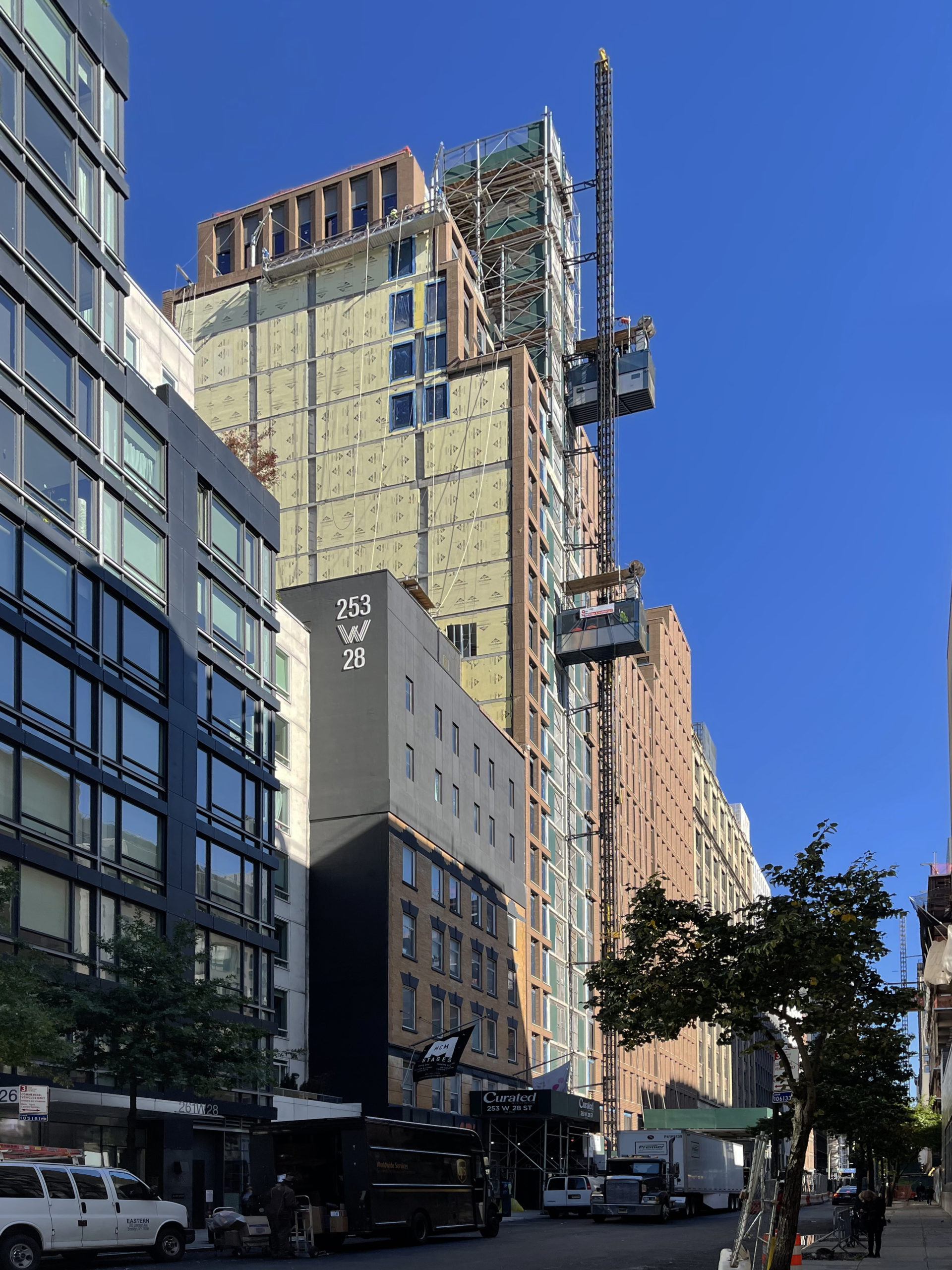
241 West 28th Street’s Brick Façade Nears Completion In Chelsea, Manhattan

Façade work nears completion on 241 West 28th Street, a pair of 22-story residential buildings in Chelsea, Manhattan. Designed by COOKFOX and developed by MAG Partners, Atalaya, Safanad, and Qualitas, the 400,000-square-foot complex is aiming for LEED Silver certification and will yield 480 units with 30 percent reserved for low- and middle-income households, as well as 8,500 square feet of ground-floor retail space. Urban Atelier Group is the general contractor for the property, which is located between Seventh and Eighth Avenues with frontage on both West 28th and 29th Streets.

At the time of our last update in May, the red brick façade had reached up to the height of the setbacks on the 28th and 29th Street elevations. Since then, crews from King Contracting Group laid the remainder of the 100,000 square feet of brick, supplied by Belden Tristate Building Materials, at a pace of one floor every two and a half days. The eastern side of the building has been enclosed in its EIFS envelope, and metal railings have begun to be installed at the base of some of the windows, with clips in place at their tops to hold a decorative paneling.

241 West 28th Street. Photo by Michael Young

Scaffolding rigs hang from both the northern and southern sides of 241 West 28th Street as workers continue to finish up the exterior. The construction elevator remains attached to the West 28th Street elevation.

241 West 28th Street. Photo by Michael Young

The towers on the western end of the building are awaiting their EIFS enclosure. Densglass sheathing insulation boards and the edges of each floor plate remain exposed for now.

241 West 28th Street. Photo by Michael Young

Residential amenities include multiple indoor lounges, a fitness center, a children’s playroom, and an outdoor lounge with a swimming pool and adjoining terrace.

YIMBY last reported that 241 West 28th Street is slated for completion in July 2023.


View Source
September 22, 2022
Bisnow

Port Covington Developer Names Office Tenant, Says Rebrand Ahead

The massive Port Covington development in Baltimore has inked its first lease, and developer MAG Partners plans to unveil a rebrand and updated master plan later this year, CEO MaryAnne Gilmartin said Thursday morning.

The H. Chambers Co., a 123-year-old interior design business currently headquartered in the Montgomery Park development in southwest Baltimore, signed a 9K SF lease at the Port Covington building dubbed E-7, Gilmartin said. 

“[It’s] an amazing company that fell in love with the ingenuity, the possibilities, and the actual quality of the buildings we’re in. So, I just want you to know that the leasing has begun, and they are our first signed lease,” Gilmartin said. 

Gilmartin announced the deal during Bisnow’s Baltimore State of the Market event on Thursday at 2455 Banner St. in Port Covington. Speaking to reporters after her remarks, Gilmartin said she expects to announce more significant leases by the fourth quarter of this year.  

Last month, news outlets published articles questioning the pace of leasing at the development and probed whether the lack of deals was a sign the project was struggling. 

The Baltimore Banner, citing anonymous sources, reported Wednesday that CFG Bank told its employees the financial institution planned to relocate its offices from Baltimore County to Port Covington. 

Gilmartin said she could not confirm or deny CFG Bank as a future tenant. No deal is done until the ink is dry on a lease, she said.   

Gilmartin also said her firm, which took over as the project’s master developer in May, plans to unveil a new master plan and a rebranding for the development later this year. 

“We’re doing a complete rebrand. A year from now we won’t be calling it Port Covington. We’re going to unveil a new name for the project at the end of this year,” she said. “We just need traction, right? Because the buildings are there.”   

There are five buildings under construction on the site as part of the $550M first phase of construction. Initial plans from Weller Development, the original master developer, called for 14M SF of retail, office and residential space off Interstate 95 on 235 acres covering the city’s southern peninsula. 

Under Armour, whose founder, Kevin Plank, initially financed the Port Covington redevelopment, is constructing the athletic brand’s new global headquarters next to Port Covington.  

Developer Mark Sapperstein also closed this week on the Locke Insulators building on the peninsula, Gilmartin said. Sapperstein’s firm, 28 Walker Development, has developed some of Baltimore’s most successful retail projects, such as The Shops at Canton Crossing and McHenry Row

However, another major property on the peninsula is heading toward vacancy. The Baltimore Sun isn’t renewing its lease at 300 East Cromwell St. and is in the process of moving operations out of the building, according to Gilmartin. 

The roughly 500K SF industrial building served for decades as the home of the newspaper’s printing operations before The Sun outsourced printing of the paper earlier this year. Since 2018, the property has also served as the newspaper’s main office after its former owner sold The Sun’s Calvert Street offices downtown.  


View Source